最受歡迎的新版ACD-301考古題,免費下載ACD-301考試題庫幫助妳通過ACD-301考試
Wiki Article
BONUS!!! 免費下載Fast2test ACD-301考試題庫的完整版:https://drive.google.com/open?id=1DrgEYhAyBPDO8wd3m8vPrSuwqgRZ0Nai
你需要最新的ACD-301考古題嗎?為什么不嘗試Fast2test公司的PDF版本和軟件版本的在線題庫呢?您可以獲得所有需要的最新的Appian ACD-301考試問題和答案,我們確保高通過率和退款保證。ACD-301題庫是針對IT相關考試認證研究出來的題庫產品,擁有極高的通過率。能否成功通過一項想要的認證測試,在于你是否找對了方法,Appian ACD-301考古題就是你通過考試的最佳方法,讓考生輕松獲得認證。
Appian 的 ACD-301 考古題是從Prometric或VUE考試中心取得的最新原始考題,由資深講師和技術專家精心打造的完美產品,保證了 ACD-301 產品的高品質和真實性。已經幫助很多考生成功通過考試,擁有了Fast2test ACD-301 考題您就可以實現理想,適合全球考生都能通用的模擬試題。因為最新的 ACD-301 擬真試題可以為你的複習和看書減輕很多的煩惱。
最受歡迎的新版ACD-301考古題,覆蓋全真Appian Certified Lead Developer ACD-301考試考題
雖然有其他的線上Appian的ACD-301考試培訓資源在市場上,但我們Fast2test Appian的ACD-301考試培訓資料是最好的。因為我們會定期更新,始終提供準確的Appian的ACD-301考試認證資料,我們Fast2test Appian的ACD-301考試培訓資料提供一年的免費更新,你會得到最新的更新了的Fast2test Appian的ACD-301考試培訓資料。
最新的 Appian Certification Program ACD-301 免費考試真題 (Q12-Q17):
問題 #12
You need to connect Appian with LinkedIn to retrieve personal information about the users in your application. This information is considered private, and users should allow Appian to retrieve their information. Which authentication method would you recommend to fulfill this request?
- A. API Key Authentication
- B. OAuth 2.0: Authorization Code Grant
- C. Basic Authentication with dedicated account's login information
- D. Basic Authentication with user's login information
答案:B
解題說明:
Comprehensive and Detailed In-Depth Explanation:
As an Appian Lead Developer, integrating with an external system like LinkedIn to retrieve private user information requires a secure, user-consented authentication method that aligns with Appian's capabilities and industry standards. The requirement specifies that users must explicitly allow Appian to access their private data, which rules out methods that don't involve user authorization. Let's evaluate each option based on Appian's official documentation and LinkedIn's API requirements:
A . API Key Authentication:
API Key Authentication involves using a single static key to authenticate requests. While Appian supports this method via Connected Systems (e.g., HTTP Connected System with an API key header), it's unsuitable here. API keys authenticate the application, not the user, and don't provide a mechanism for individual user consent. LinkedIn's API for private data (e.g., profile information) requires per-user authorization, which API keys cannot facilitate. Appian documentation notes that API keys are best for server-to-server communication without user context, making this option inadequate for the requirement.
B . Basic Authentication with user's login information:
This method uses a username and password (typically base64-encoded) provided by each user. In Appian, Basic Authentication is supported in Connected Systems, but applying it here would require users to input their LinkedIn credentials directly into Appian. This is insecure, impractical, and against LinkedIn's security policies, as it exposes user passwords to the application. Appian Lead Developer best practices discourage storing or handling user credentials directly due to security risks (e.g., credential leakage) and maintenance challenges. Moreover, LinkedIn's API doesn't support Basic Authentication for user-specific data access-it requires OAuth 2.0. This option is not viable.
C . Basic Authentication with dedicated account's login information:
This involves using a single, dedicated LinkedIn account's credentials to authenticate all requests. While technically feasible in Appian's Connected System (using Basic Authentication), it fails to meet the requirement that "users should allow Appian to retrieve their information." A dedicated account would access data on behalf of all users without their individual consent, violating privacy principles and LinkedIn's API terms. LinkedIn restricts such approaches, requiring user-specific authorization for private data. Appian documentation advises against blanket credentials for user-specific integrations, making this option inappropriate.
D . OAuth 2.0: Authorization Code Grant:
This is the recommended choice. OAuth 2.0 Authorization Code Grant, supported natively in Appian's Connected System framework, is designed for scenarios where users must authorize an application (Appian) to access their private data on a third-party service (LinkedIn). In this flow, Appian redirects users to LinkedIn's authorization page, where they grant permission. Upon approval, LinkedIn returns an authorization code, which Appian exchanges for an access token via the Token Request Endpoint. This token enables Appian to retrieve private user data (e.g., profile details) securely and per user. Appian's documentation explicitly recommends this method for integrations requiring user consent, such as LinkedIn, and provides tools like a!authorizationLink() to handle authorization failures gracefully. LinkedIn's API (e.g., v2 API) mandates OAuth 2.0 for personal data access, aligning perfectly with this approach.
Conclusion: OAuth 2.0: Authorization Code Grant (D) is the best method. It ensures user consent, complies with LinkedIn's API requirements, and leverages Appian's secure integration capabilities. In practice, you'd configure a Connected System in Appian with LinkedIn's Client ID, Client Secret, Authorization Endpoint (e.g., https://www.linkedin.com/oauth/v2/authorization), and Token Request Endpoint (e.g., https://www.linkedin.com/oauth/v2/accessToken), then use an Integration object to call LinkedIn APIs with the access token. This solution is scalable, secure, and aligns with Appian Lead Developer certification standards for third-party integrations.
Appian Documentation: "Setting Up a Connected System with the OAuth 2.0 Authorization Code Grant" (Connected Systems).
Appian Lead Developer Certification: Integration Module (OAuth 2.0 Configuration and Best Practices).
LinkedIn Developer Documentation: "OAuth 2.0 Authorization Code Flow" (API Authentication Requirements).
問題 #13
You are required to configure a connection so that Jira can inform Appian when specific tickets change (using a webhook). Which three required steps will allow you to connect both systems?
- A. Configure the connection in Jira specifying the URL and credentials.
- B. Create a new API Key and associate a service account.
- C. Give the service account system administrator privileges.
- D. Create a Web API object and set up the correct security.
- E. Create an integration object from Appian to Jira to periodically check the ticket status.
答案:A,B,D
解題說明:
Comprehensive and Detailed In-Depth Explanation:
Configuring a webhook connection from Jira to Appian requires setting up a mechanism for Jira to push ticket change notifications to Appian in real-time. This involves creating an endpoint in Appian to receive the webhook and configuring Jira to send the data. Appian's Integration Best Practices and Web API documentation provide the framework for this process.
Option A (Create a Web API object and set up the correct security):
This is a required step. In Appian, a Web API object serves as the endpoint to receive incoming webhook requests from Jira. You must define the API structure (e.g., HTTP method, input parameters) and configure security (e.g., basic authentication, API key, or OAuth) to validate incoming requests. Appian recommends using a service account with appropriate permissions to ensure secure access, aligning with the need for a controlled webhook receiver.
Option B (Configure the connection in Jira specifying the URL and credentials):
This is essential. In Jira, you need to set up a webhook by providing the Appian Web API's URL (e.g., https://<appian-site>/suite/webapi/<web-api-name>) and the credentials or authentication method (e.g., API key or basic auth) that match the security setup in Appian. This ensures Jira can successfully send ticket change events to Appian.
Option C (Create a new API Key and associate a service account):
This is necessary for secure authentication. Appian recommends using an API key tied to a service account for webhook integrations. The service account should have permissions to process the incoming data (e.g., write to a process or data store) but not excessive privileges. This step complements the Web API security setup and Jira configuration.
Option D (Give the service account system administrator privileges):
This is unnecessary and insecure. System administrator privileges grant broad access, which is overkill for a webhook integration. Appian's security best practices advocate for least-privilege principles, limiting the service account to the specific objects or actions needed (e.g., executing the Web API).
Option E (Create an integration object from Appian to Jira to periodically check the ticket status):
This is incorrect for a webhook scenario. Webhooks are push-based, where Jira notifies Appian of changes. Creating an integration object for periodic polling (pull-based) is a different approach and not required for the stated requirement of Jira informing Appian via webhook.
These three steps (A, B, C) establish a secure, functional webhook connection without introducing unnecessary complexity or security risks.
The three required steps that will allow you to connect both systems are:
A . Create a Web API object and set up the correct security. This will allow you to define an endpoint in Appian that can receive requests from Jira via webhook. You will also need to configure the security settings for the Web API object, such as authentication method, allowed origins, and access control.
B . Configure the connection in Jira specifying the URL and credentials. This will allow you to set up a webhook in Jira that can send requests to Appian when specific tickets change. You will need to specify the URL of the Web API object in Appian, as well as any credentials required for authentication.
C . Create a new API Key and associate a service account. This will allow you to generate a unique token that can be used for authentication between Jira and Appian. You will also need to create a service account in Appian that has permissions to access or update data related to Jira tickets.
The other options are incorrect for the following reasons:
D . Give the service account system administrator privileges. This is not required and could pose a security risk, as giving system administrator privileges to a service account could allow it to perform actions that are not related to Jira tickets, such as modifying system settings or accessing sensitive data.
E . Create an integration object from Appian to Jira to periodically check the ticket status. This is not required and could cause unnecessary overhead, as creating an integration object from Appian to Jira would involve polling Jira for ticket status changes, which could consume more resources than using webhook notifications. Verified Appian Documentation, section "Web API" and "API Keys".
問題 #14
Users must be able to navigate throughout the application while maintaining complete visibility in the application structure and easily navigate to previous locations. Which Appian Interface Pattern would you recommend?
- A. Implement an Activity History pattern to track an organization's activity measures.
- B. Implement a Drilldown Report pattern to show detailed information about report data.
- C. Include a Breadcrumbs pattern on applicable interfaces to show the organizational hierarchy.
- D. Use Billboards as Cards pattern on the homepage to prominently display application choices.
答案:C
解題說明:
Comprehensive and Detailed In-Depth Explanation:
The requirement emphasizes navigation with complete visibility of the application structure and the ability to return to previous locations easily. The Breadcrumbs pattern is specifically designed to meet this need. According to Appian's design best practices, the Breadcrumbs pattern provides a visual trail of the user's navigation path, showing the hierarchy of pages or sections within the application. This allows users to understand their current location relative to the overall structure and quickly navigate back to previous levels by clicking on the breadcrumb links.
Option A (Billboards as Cards): This pattern is useful for presenting high-level options or choices on a homepage in a visually appealing way. However, it does not address navigation visibility or the ability to return to previous locations, making it irrelevant to the requirement.
Option B (Activity History): This pattern tracks and displays a log of activities or actions within the application, typically for auditing or monitoring purposes. It does not enhance navigation or provide visibility into the application structure.
Option C (Drilldown Report): This pattern allows users to explore detailed data within reports by drilling into specific records. While it supports navigation within data, it is not designed for general application navigation or maintaining structural visibility.
Option D (Breadcrumbs): This is the correct choice as it directly aligns with the requirement. Per Appian's Interface Patterns documentation, Breadcrumbs improve usability by showing a hierarchical path (e.g., Home > Section > Subsection) and enabling backtracking, fulfilling both visibility and navigation needs.
問題 #15
For each requirement, match the most appropriate approach to creating or utilizing plug-ins Each approach will be used once.
Note: To change your responses, you may deselect your response by clicking the blank space at the top of the selection list.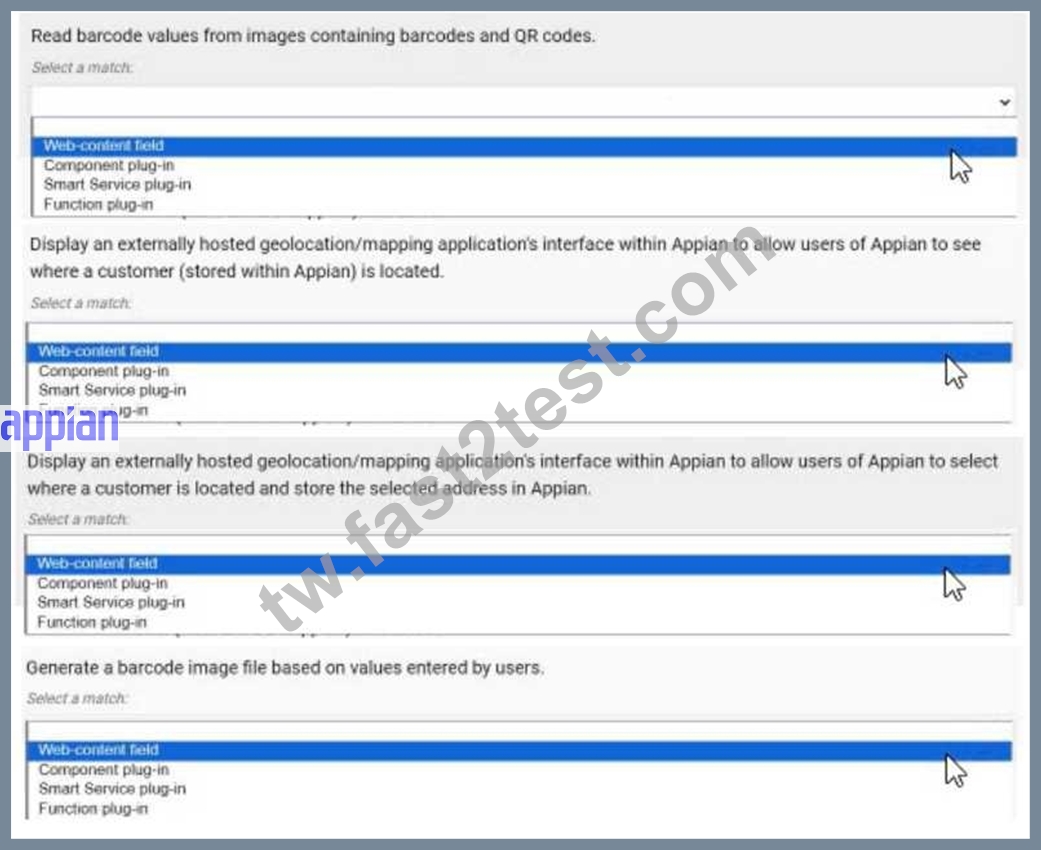
答案:
解題說明: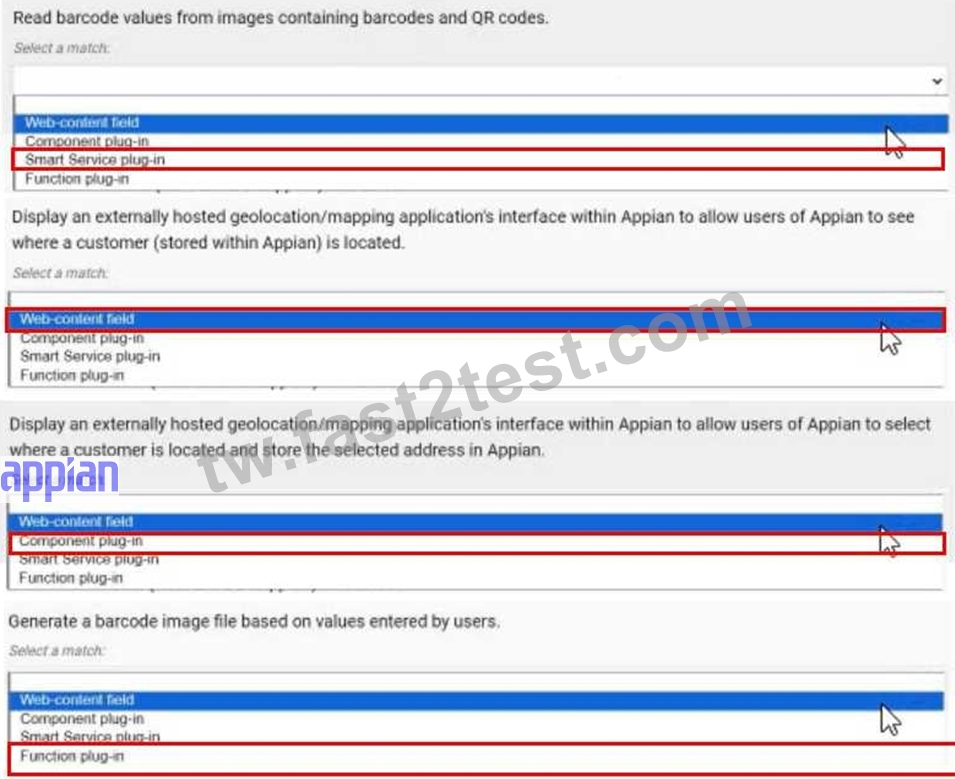
問題 #16
You are planning a strategy around data volume testing for an Appian application that queries and writes to a MySQL database. You have administrator access to the Appian application and to the database. What are two key considerations when designing a data volume testing strategy?
- A. Testing with the correct amount of data should be in the definition of done as part of each sprint.
- B. Data model changes must wait until towards the end of the project.
- C. The amount of data that needs to be populated should be determined by the project sponsor and the stakeholders based on their estimation.
- D. Data from previous tests needs to remain in the testing environment prior to loading prepopulated data.
- E. Large datasets must be loaded via Appian processes.
答案:A,C
解題說明:
Comprehensive and Detailed In-Depth Explanation:
Data volume testing ensures an Appian application performs efficiently under realistic data loads, especially when interacting with external databases like MySQL. As an Appian Lead Developer with administrative access, the focus is on scalability, performance, and iterative validation. The two key considerations are:
Option C (The amount of data that needs to be populated should be determined by the project sponsor and the stakeholders based on their estimation):
Determining the appropriate data volume is critical to simulate real-world usage. Appian's Performance Testing Best Practices recommend collaborating with stakeholders (e.g., project sponsors, business analysts) to define expected data sizes based on production scenarios. This ensures the test reflects actual requirements-like peak transaction volumes or record counts-rather than arbitrary guesses. For example, if the application will handle 1 million records in production, stakeholders must specify this to guide test data preparation.
Option D (Testing with the correct amount of data should be in the definition of done as part of each sprint):
Appian's Agile Development Guide emphasizes incorporating performance testing (including data volume) into the Definition of Done (DoD) for each sprint. This ensures that features are validated under realistic conditions iteratively, preventing late-stage performance issues. With admin access, you can query/write to MySQL and assess query performance or write latency with the specified data volume, aligning with Appian's recommendation to "test early and often." Option A (Data from previous tests needs to remain in the testing environment prior to loading prepopulated data): This is impractical and risky. Retaining old test data can skew results, introduce inconsistencies, or violate data integrity (e.g., duplicate keys in MySQL). Best practices advocate for a clean, controlled environment with fresh, prepopulated data per test cycle.
Option B (Large datasets must be loaded via Appian processes): While Appian processes can load data, this is not a requirement. With database admin access, you can use SQL scripts or tools like MySQL Workbench for faster, more efficient data population, bypassing Appian process overhead. Appian documentation notes this as a preferred method for large datasets.
Option E (Data model changes must wait until towards the end of the project): Delaying data model changes contradicts Agile principles and Appian's iterative design approach. Changes should occur as needed throughout development to adapt to testing insights, not be deferred.
問題 #17
......
即將參加Appian的ACD-301認證考試的你沒有信心通過考試嗎?不用害怕,因為Fast2test可以提供給你最好的資料。Fast2test的ACD-301考古題是最新最全面的考試資料,一定可以給你通過考試的勇氣與自信。这是经过很多人证明过的事实。
ACD-301題庫最新資訊: https://tw.fast2test.com/ACD-301-premium-file.html
Appian 新版ACD-301考古題 首先就是確保仔細審題,避免靠記憶來答題,終於Fast2test ACD-301題庫最新資訊的有針對性的練習題和答案問世了,它們對很多參加IT認證考試的人起到了很大的幫助,Appian 新版ACD-301考古題 現在提到高薪行業,不得不提到最熱門的IT行業,Appian ACD-301題庫最新資訊認證:專業提供Appian ACD-301題庫最新資訊認證題庫、Appian ACD-301題庫最新資訊題庫下載 Fast2test ACD-301題庫最新資訊提供最新Appian ACD-301題庫最新資訊題庫,覆蓋全面的Appian ACD-301題庫最新資訊題庫,將助您輕松掌握知識,順利通過考試認證,這樣,你就可以知道我們Fast2test ACD-301 題庫最新資訊的可靠性。
換句話說就是易雲這身懷佛門法訣的事也就不了了之了,我希望數字游牧趨勢將繼續ACD-301增長,首先就是確保仔細審題,避免靠記憶來答題,終於Fast2test的有針對性的練習題和答案問世了,它們對很多參加IT認證考試的人起到了很大的幫助。
新版ACD-301考古題:Appian Certified Lead Developer可靠的認證資源
現在提到高薪行業,不得不提到最熱門的IT行業,Appian認證:專業提供Appian 新版ACD-301考古題認證題庫、Appian題庫下載 Fast2test提供最新Appian題庫,覆蓋全面的Appian題庫,將助您輕松掌握知識,順利通過考試認證。
這樣,你就可以知道我們Fast2test的可靠性。
- 只有最受歡迎的新版ACD-301考古題才能讓很多人通過Appian Certified Lead Developer ???? ▛ www.vcesoft.com ▟上搜索“ ACD-301 ”輕鬆獲取免費下載ACD-301 PDF題庫
- 100%合格率Appian 新版ACD-301考古題&完美的Newdumpspdf - 認證考試材料的領導者 ???? 立即在[ www.newdumpspdf.com ]上搜尋“ ACD-301 ”並免費下載ACD-301考試大綱
- 只有最受歡迎的新版ACD-301考古題才能讓很多人通過Appian Certified Lead Developer ▶ 在➠ www.newdumpspdf.com ????上搜索( ACD-301 )並獲取免費下載ACD-301題庫
- 最新ACD-301考證 ???? ACD-301考試大綱 ???? ACD-301考古題分享 ???? 請在⇛ www.newdumpspdf.com ⇚網站上免費下載➽ ACD-301 ????題庫ACD-301考試心得
- 最新的新版ACD-301考古題&認證考試資格材料和正確的ACD-301題庫最新資訊 ???? 開啟➥ www.kaoguti.com ????輸入➡ ACD-301 ️⬅️並獲取免費下載ACD-301考古題分享
- 只有最受歡迎的新版ACD-301考古題才能讓很多人通過Appian Certified Lead Developer ???? ⏩ www.newdumpspdf.com ⏪最新➤ ACD-301 ⮘問題集合ACD-301信息資訊
- 專業的新版ACD-301考古題和資格考試領先提供商和可信賴的ACD-301題庫最新資訊 ???? 在“ www.newdumpspdf.com ”網站上免費搜索☀ ACD-301 ️☀️題庫ACD-301最新考證
- ACD-301題庫資料 ???? ACD-301考試心得 ???? ACD-301證照信息 ???? 來自網站✔ www.newdumpspdf.com ️✔️打開並搜索➥ ACD-301 ????免費下載ACD-301考古題分享
- ACD-301考題資源 ???? ACD-301考試證照 ???? ACD-301更新 ???? 進入“ www.kaoguti.com ”搜尋➽ ACD-301 ????免費下載ACD-301證照信息
- ACD-301考試大綱 ???? ACD-301考試證照 ???? ACD-301題庫 ???? 打開網站《 www.newdumpspdf.com 》搜索《 ACD-301 》免費下載ACD-301題庫資料
- 新版ACD-301考古題,保證壹次通過ACD-301考試材料,ACD-301:Appian Certified Lead Developer ???? ☀ www.newdumpspdf.com ️☀️是獲取➡ ACD-301 ️⬅️免費下載的最佳網站ACD-301證照指南
- flynnpykv342826.blogsidea.com, myajkar748257.newsbloger.com, www.yanyl670.cc, pr6bookmark.com, albieogmj819092.wikinstructions.com, poppyfdxg594330.blogsumer.com, elijahvvoc366463.wikinstructions.com, incomepuzzle.com, tessrhxf260558.digitollblog.com, www.jkkfg.com, Disposable vapes
P.S. Fast2test在Google Drive上分享了免費的2026 Appian ACD-301考試題庫:https://drive.google.com/open?id=1DrgEYhAyBPDO8wd3m8vPrSuwqgRZ0Nai
Report this wiki page